About a third of our piano students are adults. Some come to our Harrow studio. Some learn entirely on Zoom. Some do both. After a decade of teaching both formats side by side, I can tell you with confidence which one wins for which situation, and the honest answer is more nuanced than most articles online (or in-person teachers) admit.
Here is the breakdown, with the reasoning underneath.
Where in-person genuinely wins
Three things are meaningfully harder over a screen, and they all matter:
1. Hand position and posture correction. Wrist height, finger curvature, the angle of the elbow when the thumb passes under, the relationship between the seat and the keyboard. These are three-dimensional problems and a 2D camera flattens half the information. I can hear when a student is forcing the tone; I can see when their wrist drops; in person I can put my hand on theirs and let them feel the correct shape. That is a five-second fix in a real room and a fifteen-minute conversation on a screen.
2. Tone and dynamics. Microphones and laptop speakers compress dynamic range. A pianissimo on a Yamaha grand and a forte on a Yamaha grand sound less different on Zoom than they do in real life. For an adult learner working on touch sensitivity (which is where most of the musical interest lives) this is a real limitation. We work around it but we cannot remove it.
3. Real performance practice. Sitting at the same piano someone else has sat at, with the unfamiliar bench and the slightly different action, is part of learning how to play music. Online lessons happen on the student's own piano in their own room. That is comfortable, which is also part of why it never quite simulates the moment of being in front of an audience.
Where online genuinely wins
I came to this list reluctantly. Most in-person teachers would rather not say these things out loud. They are true anyway:
1. Consistency. The biggest single predictor of progress in adult learners is not the quality of the lesson; it is whether the lesson actually happens, every week, for at least a year. Online removes the half-hour drive each way, the parking, the weather, the cancellations because work ran late. Adult learners who switch from in-person to online almost always increase their lesson frequency by 30 to 50 per cent in the first three months. That alone outweighs most of the in-person quality advantages.
2. The student stays at their own piano. This sounds obvious but matters: anything we work on in the lesson is being worked on at the exact instrument the student will practise on. No translation problem between studio piano and home piano. For an adult who is going to practise on a digital instrument all week, learning on the same digital instrument in lessons makes everything they learn directly usable.
3. Recording every lesson is trivial. Zoom records the entire session on request. Going back over a tricky bit later in the week, listening to the teacher's tempo on a phrase, or comparing this week's playthrough to last week's, is one click. In-person lessons would require setting up a camera, which almost no one does.
4. Geographic range. Most adults pick a teacher within fifteen minutes of home. Online removes that constraint entirely. The right teacher for you might be in Edinburgh; the right student for me might be in Newcastle. We have students across the UK, in the Republic of Ireland, in France, in the US. They get a Trinity Laban-trained teacher who specialises in adult learners. That is not always available locally.
The hybrid that beats either
The setup I quietly recommend to most serious adult learners: one in-person lesson per month, three online lessons per month, all with the same teacher.
The monthly in-person lesson is the calibration session. Posture, technique, the things that need three-dimensional attention. The three online lessons are repertoire, theory, sight-reading, the things that benefit more from frequency than from physical proximity.
For students within driving distance of our Harrow studio, this is what most of our committed adult students actually do. For students further afield, all four lessons are online and we travel by exception (for the recital, the wedding gig, the exam preparation week).
Cost: the honest comparison
In London in 2026, the rough market rates for adult piano lessons are:
- In-person, conservatoire-trained teacher: £45 to £90 per hour. Higher in central London, lower in Zone 5 onwards.
- Online, conservatoire-trained teacher: £35 to £65 per hour. Roughly 25 to 35 per cent cheaper than in-person at the same quality tier, because the teacher saves travel time and studio overhead.
- App-based learning (Pianote, Flowkey, Skoove): £10 to £25 per month subscription. Pre-recorded video plus exercises. Useful for very early stages or as a complement to real lessons; not a substitute for a teacher beyond the first six months.
Our own pricing is on the lessons and fees page. The numbers are public, no "contact for a quote" friction.
Common myths, debunked
Myth: Adults are too old to learn piano properly. Adults learn piano differently from children but not worse. The motor learning is slower; the conceptual learning (theory, harmony, the structural understanding of a piece) is significantly faster. Most adults pass ABRSM Grade 1 within nine to twelve months of starting; ABRSM Grade 3 within two to three years. That is a perfectly respectable trajectory.
Myth: You need an acoustic piano to learn properly. A weighted-key digital piano (88 keys, with a sustain pedal) is sufficient for the first three to four years. The decision to move to an acoustic should be driven by you feeling limited by your instrument, not by what your teacher tells you to buy. Most of my online students never move to an acoustic and progress fine.
Myth: Online lessons are for hobbyists; serious students need in-person. The world has rebuilt itself around remote work in the last six years and music tuition has come with it. Some of the most committed students I have are entirely online. Some of the least committed students I have are in-person. The format is not the predictor; the consistency is.
How to choose for your situation
Ask yourself three questions, in this order:
- How likely am I to actually show up every week? If commute or scheduling are real constraints, online wins by default. There is no point paying for in-person lessons you will cancel.
- What is my goal? If you want to perform in front of others (open mic, family Christmas, a recital), in-person matters more. If you want to play for your own enjoyment in your own home, online matters less.
- What does my home setup actually look like? If you have a quiet room with a weighted-key digital piano and a laptop you can position at keyboard height, online works. If you have a cheap unweighted keyboard in a shared room with bad acoustics, in-person is going to be a meaningfully better experience until you upgrade.
A £10 trial, in person or online, before you commit
If you are considering adult piano lessons in London (or anywhere in the UK on Zoom), the cleanest way to decide which format suits you is to do a trial in each. The thirty-minute £10 trial lesson is the same price either way, and you can switch at any time without re-signing anything.
If you would like to compare the two formats before committing, just drop me a note with which works first and we will line up a slot.
You might also find the free 5 Things to Know Before Starting Piano guide useful before your first lesson. It is the pre-lesson briefing my students wish they had read.
Whichever way it goes, adult piano is a wholly different and arguably more rewarding learning experience than learning as a child. Worth taking seriously.
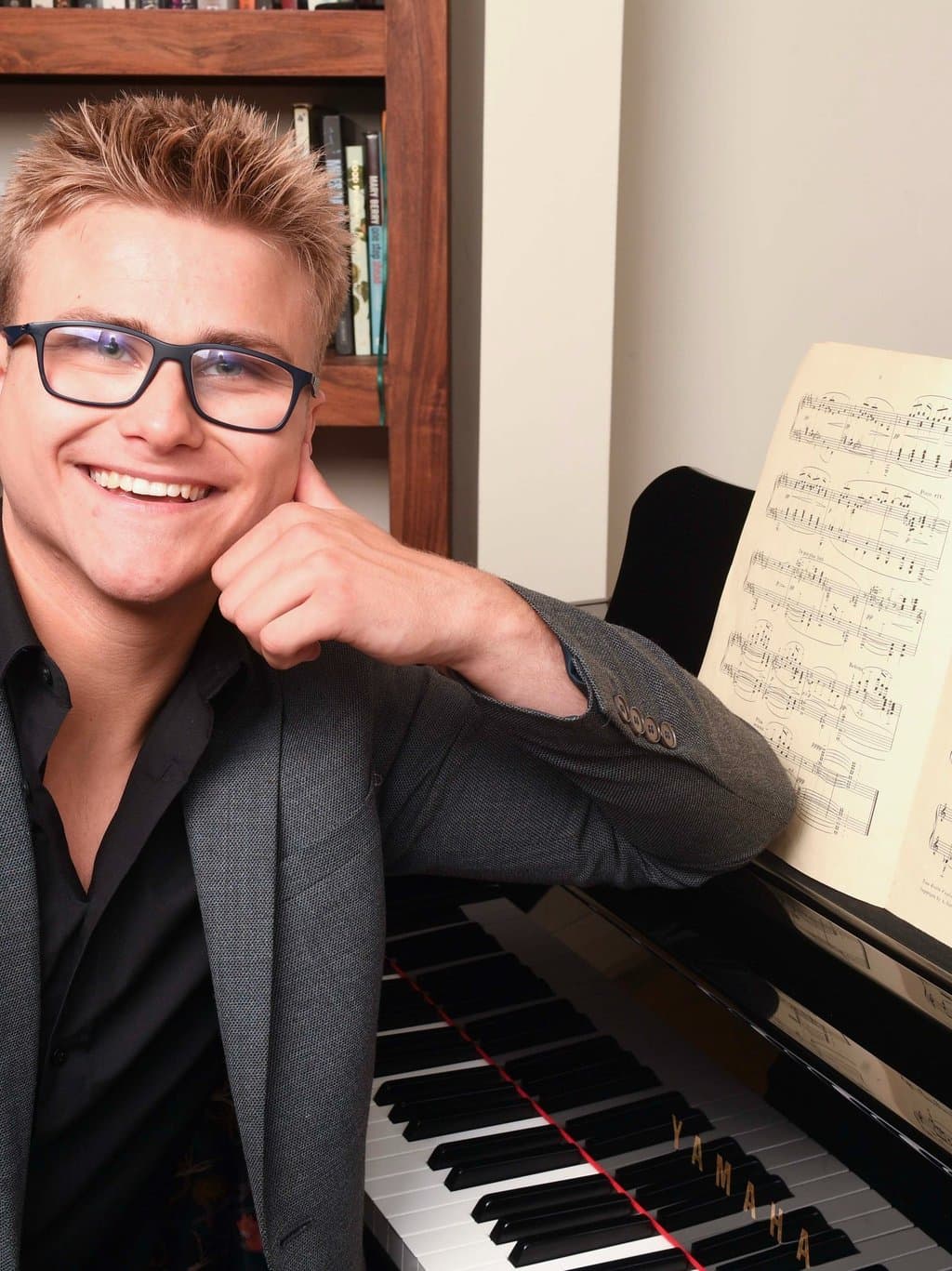
Norbert Steczkowski runs Piano with Norbert in Harrow. Trained at Trinity Laban Conservatoire of Music and Dance, he performs classical and jazz piano across London and teaches adult learners in person and online across the UK.
Ready to put this into practice? Book a trial piano lesson with a conservatoire-trained teacher.
Written by
Norbert Steczkowski
Trinity Laban-trained pianist and piano teacher at Piano with Norbert. Active performer across London. Serving Harrow, Pinner, Stanmore and surrounding areas. More about the team →